Release notes
LABS351 Changelog
Technical changes and platform evolutions across LABS351 releases.
LABS351 3.5.3 · Search, Navigation and Extraction
Symbol Search and Navigation to Decoded Code
LABS351 3.5.3 will extend search and navigation capabilities to directly connect symbols, project sources and decoded machine code.
Source search will identify occurrences of a symbol in the current document or across all files in the VFS, making it possible to locate multiple occurrences and duplicate symbols.
From the symbol view, navigation to the disassembly will rely directly on the symbol address obtained from binary analysis. LABS351 will locate the corresponding code section, find the associated instruction and automatically position the view on the page and line containing the symbol.
- Search for a symbol in the current document
- Search across all files in the VFS
- Identification of multiple occurrences of the same symbol
- Detection of duplicate symbols across project sources
- Clear distinction between source search and navigation within the analyzed binary
- Direct navigation from the symbol view to decoded machine code
-
Symbol localization within its
.textor__textsection - Symbol address lookup within decoded instructions
- Automatic selection of the corresponding disassembly page
- Automatic positioning on the instruction associated with the symbol
- Visual selection of the instruction corresponding to the symbol address
LABS351 3.5.3 will also introduce contextual actions for extracting a selection cleanly from the disassembly view.
Extraction will operate directly on the decoded instructions associated with the selected lines, independently of their representation across the different interface columns.
- Copy disassembled instructions
- Copy addresses and instructions
- Extract opcode bytes
- Copy a complete representation of the selected disassembly
- Preserve decoding information independently of the table presentation
LABS351 3.5.2 · Symbol Analysis and ABI Validation
Multi-format Symbol Analysis
LABS351 3.5.2 extends native symbol analysis for ELF, Mach-O and PE/COFF binaries while preserving the semantics specific to each executable format.
Symbol origin, binding and section association are now exposed more precisely, while C++ symbol names are normalized and demangled for display.
BinaryAnalyzer also identifies a candidate symbol directly from the symbols present in the analyzed binary. The selected symbol is visually identified in the symbol view.
-
Analysis of ELF symbol tables
.symtaband.dynsym - Distinction between dynamic and regular ELF symbols, including local, global, weak, imported and undefined bindings
- Native classification of local, external and imported Mach-O symbols
- Classification of PE/COFF symbols, exports and imports
- C++ symbol demangling and display normalization
- Automatic detection of a candidate symbol from the analyzed binary
- Visual identification of the selected symbol for ELF, Mach-O and PE/COFF
LABS351 3.5.2 extends runtime ABI validation to non-volatile SIMD/FP registers that must be preserved by the called function.
This extends the existing general-purpose register (GPR) validation. LABS351 can now simultaneously detect a violation affecting a general-purpose register and a violation affecting a SIMD/FP register.
On ARM64/AAPCS64, validation covers the lower
64 bits of registers V8 through
V15. On Windows x86-64 using the
Microsoft x64 ABI, it covers all 128 bits of
registers XMM6 through
XMM15.
When a violation is detected, the affected register is identified in the ABI diagnostics and visually highlighted in the NEON or XMM register view. The existing ABI status now incorporates both GPR and SIMD/FP violations, while stack validation remains independent.
-
V8–V15— validation of the lower 64 bits on ARM64/AAPCS64 -
XMM6–XMM15— validation of all 128 bits on Windows x86-64 / Microsoft x64 - Simultaneous detection of GPR and SIMD/FP violations
- Identification of affected registers in ABI diagnostics
- Visual highlighting of registers in violation in the NEON and XMM views
- Stack validation remains independent from register state
LABS351 3.5.1 · ARM64 / AARCH64
Extended ARM64 Runtime Introspection
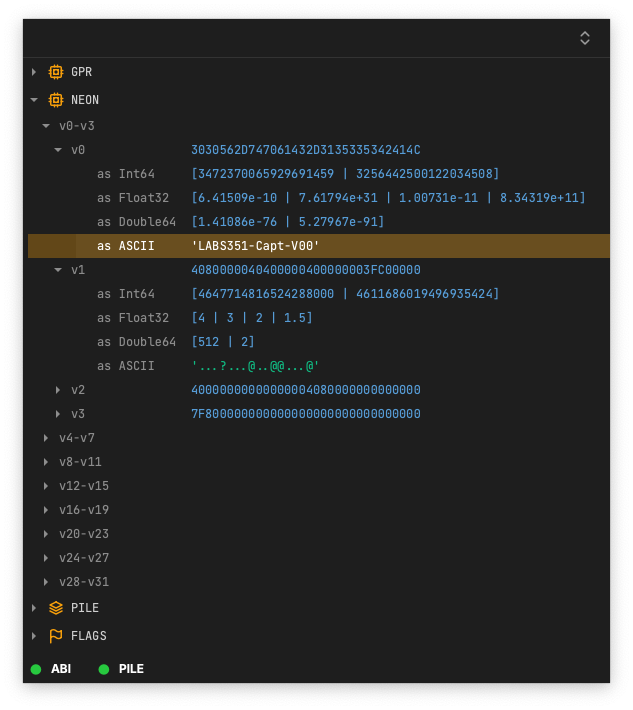
LABS351 3.5.1 extends ARM64 runtime introspection with complete capture of the 32 architectural 128-bit SIMD/FP registers, from V0 through V31.
NEON register contents can be inspected as raw 128-bit values and through typed representations, including integer, Float32, Double64 and ASCII views.
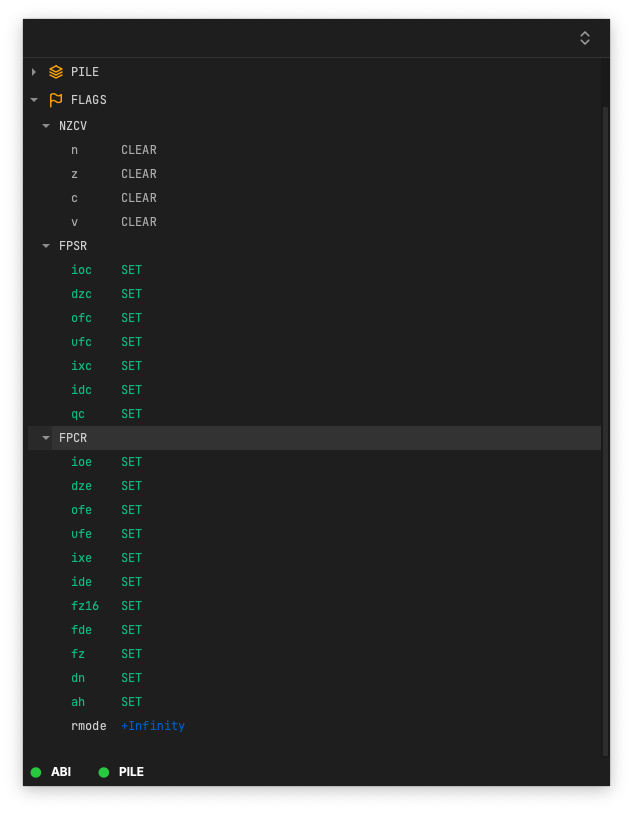
Floating-point runtime state has also been extended with dedicated FPSR and FPCR capture and decoding. Exception status, floating-point controls and the active rounding mode are exposed directly in the register inspector.
V0–V31— 32 × 128-bit SIMD/FP registersFPSR— Floating-Point Status RegisterFPCR— Floating-Point Control RegisterNZCV— condition flags- Typed SIMD interpretation
- Independent ABI and stack validation
LABS351 3.5.1 refines PE/COFF binary handling by distinguishing the virtual size of a section from its physically aligned size in the file.
For PE sections, the debugger now takes
VirtualSize into account when it
is smaller than SizeOfRawData.
Alignment padding present in the file is
therefore no longer passed to the decoding
engine as if it belonged to the useful virtual
area of the section.
This change is strictly limited to the PE/COFF format and does not modify ELF or Mach-O section handling.
LABS351 3.5.1 also introduces explicit control over the symbol export policy when generating shared libraries.
A new project option allows automatic export directives generated by LABS351 to be enabled or disabled. When disabled, the native behavior of the selected linker is preserved. When enabled, LABS351 explicitly generates export directives for eligible global symbols.
-
VirtualSizeis now taken into account when decoding PE/COFF sections -
Padding associated with
SizeOfRawDatais excluded when it exceeds the virtual size - No changes to ELF or Mach-O handling
- New project option for automatic export of global symbols
- Ability to preserve the linker's native export behavior
-
Comparative validation of PE/COFF export
parsing against GNU
objdump